Roles that match how agencies work
Admins configure endpoints and triage incidents. Members watch and report. Membership is per workspace.
Multi-tenant uptime monitoring
Each client gets an isolated workspace, its own endpoints and incident history,
and a public status URL at /status/<client>. Operators sign
in to the workspace they belong to, keeping each client’s dashboard separate.
Self-hostable. Runs on Postgres. No agent to install on anything.
Illustrative workspaces. Names and figures are examples, not customers.
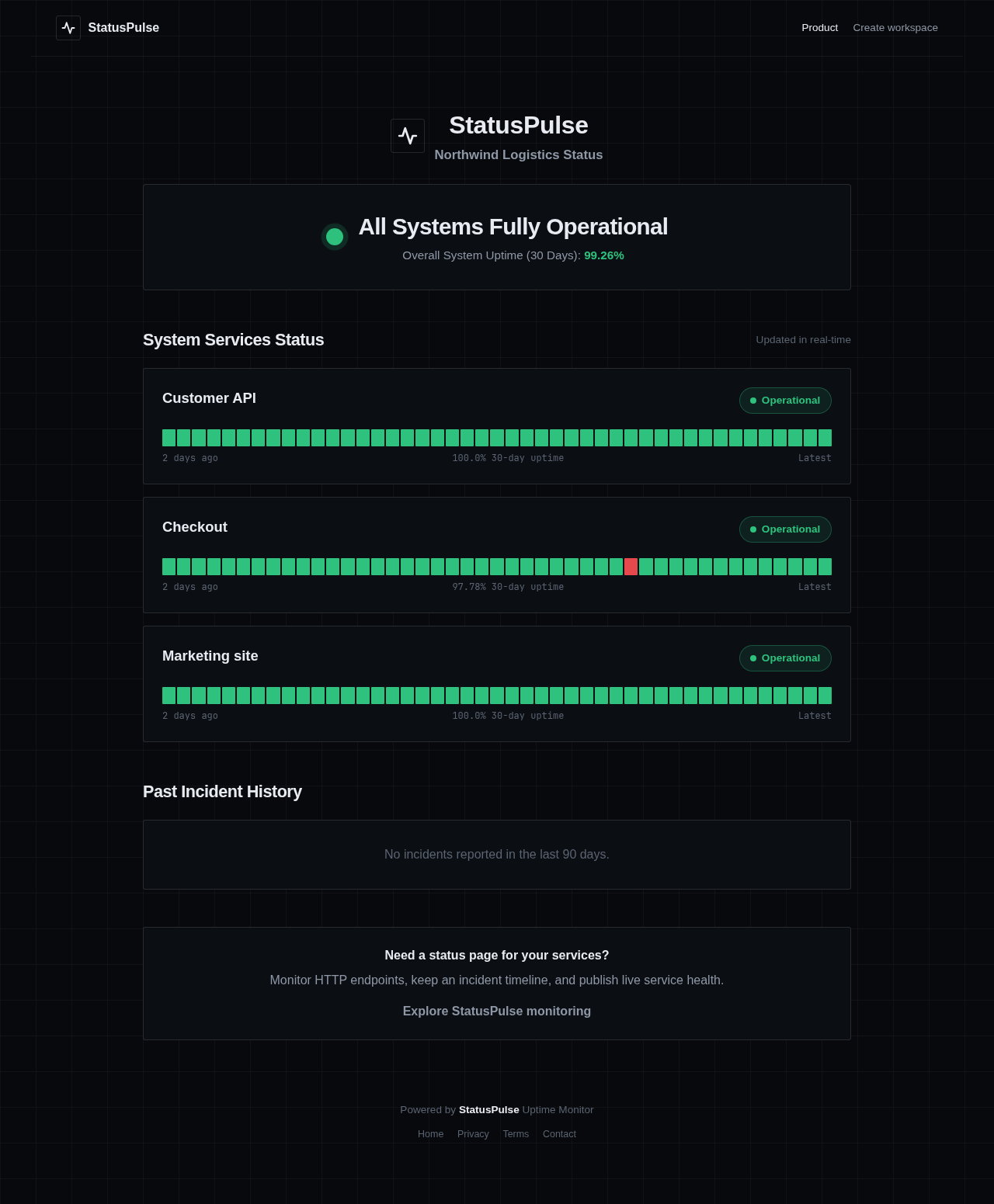
Public status, rendered
Status pages render service state, uptime figures, history bars, certificate warnings, and incidents from workspace records. The separate live demo is backed by scheduled HTTP checks.
Org-isolated
Endpoints, incidents, maintenance windows, users and reports all belong to an organization. A client’s data is scoped to their workspace at the query level, not hidden in the interface.
Admins configure endpoints and triage incidents. Members watch and report. Membership is per workspace.
Every workspace publishes to /status/<client> — a page you can hand a client without exposing anything else.
Creating an account creates the workspace with it. No provisioning step, no seats to allocate before you can start watching something.
GET · POST · PUT · PATCH · DELETE · HEAD · OPTIONS
Real systems need more than a GET against the homepage. Authenticate the check, send a body, and assert on what comes back.
Bearer tokens and API keys per endpoint, as JSON or plain Header: Value lines.
Send a payload with POST, PUT and PATCH checks — exercise the endpoint the way a client does.
Match an expected status code, and require a string in the response body. A 200 that returns the wrong thing is still an outage.
Per-endpoint intervals and timeouts. A payments API can run every 30s while a marketing site runs every 5 minutes.
SLA · P90 · 7 / 30 / 90 days
Uptime against the windows that appear in service agreements, and latency measured at the percentile that shows the problem. Averages hide the bad tail; P90 is where a client’s complaint lives.
Every workspace can send its team a weekly SLA summary on Monday morning. Send it early and the uptime conversation is already had.
Investigating, identified, monitoring, resolved — each with timestamped updates and the services it touched, kept against the workspace.
Public · per client
/status/<client>.When something breaks, a client’s customers go looking. Give them a page to find: current state per service, the check history, and the incident timeline — updating live, without a refresh.
Open a live status pageCreate a workspace, point it at an endpoint, and watch the first check land.
Create a workspaceQuestions
The practical details agencies and self-hosters usually need before creating a workspace.
No. A user belongs to one workspace, which keeps each client dashboard and its operational data separate.
Checks support seven HTTP methods, custom headers, request bodies for POST, PUT, and PATCH, expected status codes, response-text assertions, intervals, and timeouts.
The hosted deployment retains check logs for 90 days, matching the longest reporting window. Other workspace records are stored separately.
There is currently no software subscription charge. Self-hosters pay for their own infrastructure and any third-party services they choose.