UptimeRobot
Good at uptime checks. A typical agency account is single-tenant: every client’s monitors share one list, or each client becomes another login to juggle. That is not an isolated workspace.
Statuspage alternative for agencies
UptimeRobot is built for uptime checks in a single-tenant account. Atlassian Statuspage is built for status communication, not agency isolation. StatusPulse is the agency-shaped middle: one isolated workspace per client, real HTTP checks, and a public /status/<client> URL.
Self-hostable. Runs on Postgres. No agent to install on client infrastructure.
Honest split
Agencies that cannot mix client data outgrow a shared monitor list and a status-comms tool that is not a workspace. StatusPulse keeps checks, incidents, and the public status URL inside the same client boundary.
Good at uptime checks. A typical agency account is single-tenant: every client’s monitors share one list, or each client becomes another login to juggle. That is not an isolated workspace.
Good at status communication. It is not uptime monitoring for agencies and it is not built to isolate one client’s operational data from another’s.
The agency-shaped middle. Isolated client workspaces, HTTP checks, an incident paper trail, SLA reports, and a public /status/<client> page with no shared dashboard bleed.
What the client sees
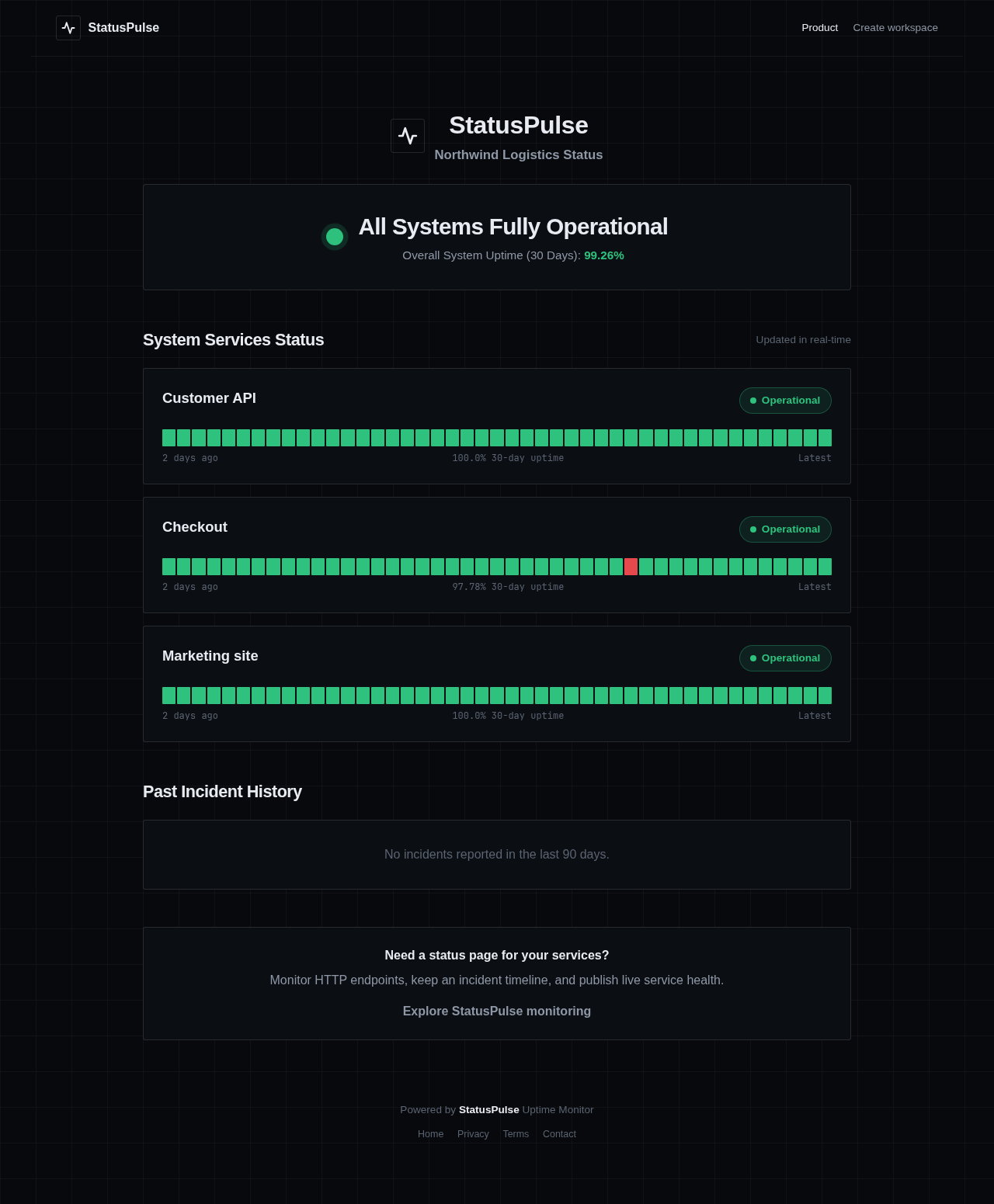
What ships in the workspace
If you need UptimeRobot for client workspaces — real HTTP checks without a shared monitor list — the workspace is the unit. Operators sign in to the workspace they belong to.
Endpoints, incidents, users, reports, and maintenance windows stay scoped to one client. Nothing bleeds into another dashboard.
GET, POST, PUT, PATCH, DELETE, HEAD, and OPTIONS with headers, request bodies, expected status codes, and response text assertions.
Incidents keep a paper trail. Reports cover 7, 30, and 90-day uptime plus P90 latency for the workspace that owns the checks.
Create the workspace, point it at an endpoint, and publish /status/<client> when you are ready.
Questions
Yes, for agencies that need a public status URL per client plus isolated operational data. Atlassian Statuspage is status communication. StatusPulse publishes /status/<client> from the same workspace that runs the checks.
UptimeRobot is built around uptime checks in a single-tenant account. StatusPulse runs real HTTP checks too, but each client gets an isolated workspace so monitors, incidents, and status pages do not mix.
Yes. Every workspace publishes at /status/<client>. Stakeholders see that client’s services and incidents only — no shared dashboard bleed.
Yes. StatusPulse is self-hostable, runs on Postgres, and does not require an agent on client infrastructure.